|
|
|
|
|
|||
|
|
|
|
|
|||
|
|
|
|
|
|||
|
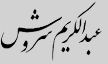
Conversation with AbdolKarim Soroush Intellectuals: The Powerless Wielders of Power |
||||||
|
|
|
In the name of God, the Compassionate, the Merciful Q. One of the issues that has exercised your mind in recent years has been the relationship between knowledge and power, and especially the relationship between the bearers of power and knowledge. First, in a speech entitled The Expectations Universities Have of Seminaries, you analyzed the relationship between the clergy and power. You expanded on this in the autumn of 1994, in a speech entitled Liberty and the Clergy, and again, in September 1995, in the speech The Canopy of Materialism over the Pillars of the Shari’ah. In July 1995, you touched on the question of religious intellectuals and power towards the end of a speech entitled Analysis of the Meaning of Religious Government. And, in a speech in August 1997, delivered at the camp of the Daftar-e Tahkim-e Vahdat association of university students, you spoke at greater length about the relationship between religious intellectualism and power. In the light of all this, what exactly is the relationship between knowledge and power? Foucault reduced knowledge to power. In view of the fact that you reject the reduction of reason to cause, how do you view the relationship between the two? A. You’ve raised a good point. I’ve been thinking about the relationship between knowledge and power for some time. An article you didn’t mention is Knowledge and Justice. I said there that justice today involves not only a fair distribution of wealth and power, but also a fair distribution of « knowledge », because in the new world information is a major component of power, and governance and leadership are absolutely impossible without knowledge and information. (I touched on this same issue in the article Freedom as Method.) The way we live basically corresponds to the extent and nature of the information at our disposal. Pastoral and feudal life corresponded to the information available at that time and industrial life corresponds to the current level of information. And these modes of life undoubtedly affect the realm of politics and government. Information has always been vital and decisive, and today this is more intensely the case than ever before. The French Revolution was expedited by clandestine leaflets, the Iranian Constitutional Revolution by telegraph wires and the Islamic Revolution by audio-cassettes. These are all bearers of information. Moreover, today, the empirical sciences (whether the natural sciences or the social sciences) play a big role in running societies’ affairs, such that civil society can also be described as scientific society; that is to say, a society that is run in a scientific manner in which civil liberties are defined in terms of scientific liberties. Much the same can be said of the part played by intellectuals, who are the initiators of ideas and can be the harbingers of tremendous events. All this has turned knowledge into a tremendous power in the new world; setting aside ideologies which, in the opinion of Marxists, consist of false information, unreasoned but caused, and which have a dramatic role to play, acting single-handedly with the force of a well-equipped army to capture people’s consciousness. Even in non-ideological societies, the culturally determining role played by the media cannot be underestimated; in fact, they can have an awesome force, making human beings bend this way and that like saplings in a storm. Thus, although science and power have always gone hand in hand, the relationship between the two has now become much stronger and more extensive. This is why people speak of truth-making in today’s world or about truth as convention. The conventionality of truth means that we define the truth and influence people’s consciousness in such a way as to make them see something as true and something else as false. It is in this context that Foucault’s theory about truth-power comes to light and takes on meaning. He says that truth is inextricably intertwined with power. Habermas puts forward a similar position in one of his major works, Knowledge and Human Interest. Here, he argues that knowledge is underpinned by human interests and that the nature of knowledge or scientific investigation varies depending on whether the underlying interest is understanding, control or emancipation. Knowledge bent on understanding is interpretative; knowledge bent on control is empirical; and knowledge bent on emancipation is critical. It is in this sense that Habermas speaks of knowledge-constitutive human interests. In other words, values are deeply ingrained in modern knowledge; values that are tied up with power. There are differences and similarities between Foucault’s position and Habermas’s ideas. Foucault looks at the way culture is interwoven into power or power interwoven into culture. He is more interested in trying to discover when and where something becomes a suitable « subject » for scientific inquiry. The fact that something becomes a subject is not arbitrary. It is also the case that the judgments made about a subject (that is, its qualities and attributes) are accepted by the scientific community under specific circumstances. He says that those who see Marxism as « scientific » and those who consider it to be unscientific have both reached consensus on what science means; it is this consensus which exercises a hold on people’s minds, bringing everything - Marxist and non-Marxist - under its sway. He thinks about how and why a state comes into being and how it takes hold, bringing scientists under its domination as opponents or proponents. He believes that the new age has given a power to science and scientific methodology that they didn’t have before. He says, it is not just a question of whether something is true or not, but whether it is taken seriously, and this being taken seriously is related to power. Many are the truths that have disappeared into oblivion and been ignored by the scientific community, thereby failing to attain any power in practice. At any rate, as far as he is concerned, science is not just a matter of seeking the truth. It is a sophisticated, social activity undertaken by scientists which itself constitutes power and is closely intertwined with society’s other institutions of power. His views are very close to those of Thomas Kuhn. And, of course, since he sees any truth as being dependent on a specific political regime, he makes it impossible for himself to criticize power. Rorty, Habermas and Charles Taylor take issue with him on precisely this point. When it’s a question of the relationship between power and justice or knowledge and justice, I find it hard to forget the view Bertrand Russell puts forward in the book Power, where he says: Power is like energy; just as energy comes in different forms that can change into one another, power, too, can be said to come in different forms that can change into one another. I have to say here that I am prepared to go along with Foucault, Kuhn, etc. in so far as the social and historical dimensions of knowledge are concerned. But when it comes to sacrificing reason at the altar of cause, which lies at the heart of Foucault’s project, I must part company with them. In fact, rather than undermining the ruthless masters of the world, such a position strengthens them. And, as far as knowledge and reason are concerned, I respect rationality too highly to have it sacrificed to expediency and interests. The post-modernist project, which engages in a sacred battle against arrogant rationality, chooses to see rationality dead instead of wishing to see it humble. This is a modern version of arrogant obscurantism that turns into its own opposite. At any rate, what is at issue here is actually existing power and actually existing science and the relationship between the two, not the quintessence of truth and quintessence of knowledge and their ideal, logical, rational relationship. Q. In the speech The Expectations Universities Have of Seminaries, you said that the clergy has always behaved like a disciplined party and it is now a party that has come to power. You went on to mention three pitfalls associated with the intermingling of learning and power: first, that seminaries should speak in the language of power instead of the language of logic; secondly, that they should compensate with power any shortcoming in knowledge and logic; thirdly, that they should act as power’s ideologues and apologists, such that, in their theories on government, they tailor their views and fatwas to suit the rulers, instead of guiding and criticizing them, or that they should shut the door to debate on certain theoretical subjects. In the Analysis of the Meaning of Religious Government, you say the following about intellectuals: « The task of the intellectual is to fulfill secondary needs, and they are the producers of ideas, art, critiques and opinions. Their path is there by separate from - although not necessarily opposed to - that of the state, which must fulfill primary needs. The state uses intellectuals and has to have an intellectual base. But intellectual work, which has no class interest, must not become entangled with the work of the bureaucratic state machinery, which does have a class base. All this calls to mind the famous narrative attributed to the Prophet that says: ‘The best rulers are those who serve learned men and the worst learned men are those who serve rulers.’ The two must maintain their independence. The state must not wish to see intellectuals as its cronies and servants, for this would only serve to corrupt and distort intellectual work. The independence of learned people from rulers is not only at issue under oppressive states; the very nature of thought and intellectual work demands independence from power and the fulfillment of secondary needs wouldn’t be possible in the absence of this independence. As a rule, cultural power in society must be distinct from political power so that it can, where necessary, move to adjust and correct political power, while at the same time attending to society’s moral and mental growth and elevation. At any rate, a state intellectual is not an intellectual. » And, finally, in your most recent speech, you warned religious intellectuals against seeking political power in any shape or form whatsoever. What is the reasoning behind this verdict? A. It is exactly the same reasoning as the one that made me warn clerics against sidling up to power. The same thing applies here. Clerics must not seek to benefit from religion and intellectuals must not seek to benefit from intellectual work, and a religious intellectual must not benefit from either! And benefit covers a multitude of sins, ranging from wealth to power to political posts; it includes all these things. An intellectual’s mind should be occupied with untying and resolving general, theoretical knots; whereas a politician’s mind should be occupied, in the first instance, with untying specific, basic knots. A politician’s work has to do with the requirements of the moment, whereas an intellectual’s work is cultural and historical. An intellectual must, first and foremost, engage in theoretical innovation and the production of ideas. Even if certain junctural circumstances force him to abandon this position, it would only be a passing matter, not altering the essential nature of intellectual work. What I was saying at that seminar (on 10th August 1997 at the Tahkim-e Vahdat student camp) was that revolutions and progressive movements have a theoretical dimension as well as a practical dimension. The theoretical dimension is supplied by intellectuals (who have a commanding view of the rupture between modernity and tradition, and are privy to its secrets). Without this theoretical dimension, a revolution is nothing but a temporary rebellion. This is not a post that can remain vacant. Of course, it demands levels of courage to which not everyone can aspire. And, in order for this courage to be safeguarded, it is essential and imperative that all interests - especially seductive interests relating to power - be shunned. If states and political parties can be said to have a role to play, it is to protect this demanding post, without which there can be no development or growth. No leap forward comes about without an impetus and, if the politicians are the leapers, intellectuals supply the impetus. The question is where to leap. I think what makes the intellectual’s disdain for power seem strange and possibly even irritating is that we always hear it said that the intellectual is a critic or a protester, or, as some people would put it, a professional grumbler. This is why it is often said, let us give the task to the intellectuals themselves and see if they can do any better. The intention here is to confront intellectuals with impediments. Whereas, if we do not define intellectuals as being primarily engaged in criticism and protest - although these are praiseworthy things in their own right - and say instead that intellectuals’ principle task and contribution is to innovate, we will appreciate their position and not look for pretexts to eliminate or silence them. We would not then say that this professional grumbler wouldn’t even be able to run a school or a factory, let alone a big country. If we place intellectuals in their proper place and have the right expectations of them, that is: 1. insight; 2. boldness; 3. theoretical innovation in times of crisis, rupture and transition; and 4. multi-sourced ness, then we will not expect them to do things that others can do, but only things that they alone can do. This amounts to nothing more than safeguarding society’s capital and putting it to the best use. Another mistake is the assumption many make in thinking that an intellectual means someone who has gone to university and is well educated or is a poet or a novelist or an essayist. Yes, an intellectual is educated, but not every educated person is an intellectual. This is especially the case with religious intellectuals who must not only have a commanding view and ease of movement regarding the links and ruptures between the old and the new, but must also be insightful enough to distinguish between mundane religion and elevated religion; must, while maintaining their devotion to religion, not fall into narrow-mindedness and not confuse the peripheral with the fundamental; must be capable of distinguishing the incidental from the essential; must know and understand religion’s position in the present age; must know the difference between husk and kernel; and must investigate in earnest the relationship between rationality and religion. Educated people are likely to be the distributors of intellectual products and not necessarily innovative and creative intellectuals in themselves. Although if someone is no more than a distributor, he is not an intellectual, nonetheless, there is no such thing as a pure innovator or creator either. These two form the extreme limits of a spectrum consisting of elements that are either more inclined to innovation and production or to consumption and distribution. True intellectuals are those in whom innovation and production are the dominant force. In any case, I must stress that the gist and purport of what I’m saying is not an attempt to dissuade responsible, sympathetic, compassionate people of good will from serving the public or working for the state or helping people, and achieving development, well being and honor for the country. I am only speaking here about the specific responsibility of intellectuals and the specific meaning of this term. Q. If I remember correctly, in one of your discussions about the pitfalls plaguing intellectuals who become tainted with political power, you referred to two problems: first, that if an intellectual, whose task is theoretical innovation, should find himself lacking in reasoning, he might compensate for this shortcoming with power; secondly, that an intellectual might wish to impose his own mentality on society at large, demanding that others think as he does. Apart from these two, can you think of any other pitfalls looming before the intellectual who moves close to power? A. Those are the two main dangers. Another great danger is that one may lose one’s practical and theoretical boldness when tempted by power. Intellectual work does not consist of producing ideologies; that is to say, it is not the production of social designs from on high. But this is exactly what has happened in many societies. In other words, intellectuals have tried to produce designs from on high and to force society to accept their particular designs, with unpleasant and bitter consequences. At any rate, whether it’s a cleric or a critical and innovative intellectual, no sooner has he attained power than he becomes a different person, be it political power or power resulting from intellectual activity. We mustn’t forget that individuals are not immutable or cast in stone, no sooner do they mount a different steed than they become a different rider. The creative intellectual is not immune from human weaknesses and shortcomings any more than anyone else. And he can fall into dangerous ethical and political straits. There are lessons to be learnt from the story of Hegel and Heidegger and their proximity to the masters of political power. Heidegger joined the German National Socialist Party in 1933 and, with the help of the party, he became the head of Freiburg University. He made obedience to the Führer his guiding principle and he called himself Führer of Freiburg University. Pledging allegiance to the National Socialist Party and Hitler, he cut the financial assistance to Marxist and Jewish students. He helped the Nazis’ security forces in their investigations into the political tendencies of a number students and lecturers. And he remained a member of the party till the very end of his life. You can always sense a whiff of compromise in the words of a philosopher of this kind, making his philosophy ultimately suspect. The nihilism he attributed to the entire history of the West applied most of all to himself. All this is if we assume that he was a weak-willed admirer of power. However, if it’s the case that fascism was inherent to his philosophy and that his teleological critique of western metaphysics was based on a conscious sacrifice of reason at the altar of cause and a refusal to subject metaphysics to the critique of reason; if we consider his disdain for reasoning to have been an essential part of a worship of history and power intrinsic to his philosophy, then his joining the National Socialist Party and his admiration for Hitler must be taken to mean something completely different, with much more base and reprehensible connotations. In our society, too, there were people who harped on about the ending of the age of metaphysics (parroting Heidegger), but we saw the kind of somersaults they executed after the revolution, turning into fervent supporters of metaphysics and Platonic guardianship. We saw where they eventually ended up and the antics which resulted from the historical extension! of their ideas (the Ansar’s attacks on universities, the attacks by the journals affiliated to them against intellectuals, and so on). The intellectual must also not make the mistake of thinking that the attainment of power would allow him to exercise a constructive mastery over the country’s cultural affairs. As a rule, politicians and statesmen are incapable of and not responsible for producing culture. It is the people who produce culture and the most that politicians can do is to remove the chains from the hands and feet of its creators. Thus, even the delusion that intellectuals can strengthen culture by taking power is without foundation. They can be of much greater service to culture and society by staying away from power. Q. In the Analysis of the Meaning of Religious Government, you said: « The state has class interests and the intellectual does not have class interests. » Is what you’re saying here similar to Mannheim’s idea of intellectuals as a floating class? A. Yes, that’s right. We must definitely see intellectuals as a « stratum », not as a class standing in relation to some specific means of production. I’m of the opinion that, when clerics, as a particular stratum of society with particular professional and sectional interests, come to power, the result cannot be promising for the country’s political affairs. And there can be no doubt whatsoever that the clergy has specific professional interests and inclinations. We all saw and read the words of the cleric who said before the 23rd May 1997 presidential election: The next president must be a cleric so that the results of the efforts of the outgoing president are not credited to some non-cleric who succeeds him in power. Of course, some people must be politicians and concern themselves with class and national interests, instead of thinking about their interests as a profession. The state must essentially address people’s basic needs and leave secondary needs (art, religion, culture, etc.) to the relevant creators. In his book Ideology and Utopia, Karl Mannheim’s attempts to overcome the enormous difficulty of defining intellectuals led him to the conclusion that intellectuals constitute a floating stratum and, as such, do not belong to any specific class; that they can emerge from any class, the bourgeoisie or labor, and still make an impact on society and the nation as a whole. Let us recall Alvin Gouldner’s words when he said that Marx was incapable of explaining his own existence! At any rate, regardless of the definitions provided by Mannheim and others describing intellectuals as theoretical innovators and creators of ideas, it should be said, first, that intellectuals are few and far between. And, secondly, their class origin does not have any bearing on their existence; it is by their actions that they achieve their prominent role in society. Q. Today, all socio-civil institutions are, in a sense, instruments of power or a means of distributing power. When you say, « an intellectual must not seek power », does this merely fence off political parties, which are wholly political, or does it extend to other social institutions, such as the press, which falls midway between books and political parties and serves to disseminate intellectual ideas? What I’m trying to ask is, how broadly do you define the fenced-off area? A. It is very difficult to separate different types of power. I already mentioned Russell’s view that power can take on different forms. At times, it may be purely political. At other times, it may appear in more intangible forms. Books and journals and the like are more intangible than parties. An army constitutes military power. The clergy constitutes religious power. Even a clever speaker can exercise considerable power, as can a president, a trade union leader or the editor in chief of a newspaper with a circulation of five million. All of these things constitute power. And all of these powers may benefit from intellectual ideas, but an innovative intellectual does not engage in intellectual activity in order to attain any of these positions. Innovative thought is far too important to be expended on or directed at the attainment of such positions. To put it more clearly and precisely, I’d have to say that an intellectual must not become a consumer of the political gains and powers his ideas generate. He must confine himself to being a producer. If a political party follows the ideas of a creative intellectual, it is the party that is the consumer; the intellectual himself must not benefit from the effects of his views. That is to say, if a party comes to power on the back of his ideas, the intellectual must be given no part in that power. Or if a publication wins some advantage or a share of power as a result of publishing, explaining and disseminating an intellectual’s ideas, that share must not accrue to the intellectual in any shape or form. The liberty that is befitting to the clergy, which I have spoken about on other occasions, is also befitting to intellectuals (religious or otherwise). Seeking personal gain from guidance and enlightenment is wrong, be it in the realm of religion or in the realm of human affairs in general. In brief, an intellectual’s ideas flow like blood in the veins of the various manifestations of power, such as the press, political parties, etc., but the intellectual himself must not partake of that blood! In other words, an intellectual’s work is not conditional on or undertaken in the hope of recompense; it entails deprivation, it does not entail any gain. His attributes can be likened to those of a candle or the sun. They are encapsulated in the shedding of light and clarity, in generosity and munificence, as well as in boldness and thoughtfulness. This generosity and enlightenment in the realm of production and this avoidance of political gain does not mean that the intellectual must shun political activity and sit idly by when confronted with a struggle between justice and injustice. He forswears gain to allow himself greater room for maneuver and to be able to carry out his duties as a human being - which may at times involve direct political action - more boldly and more sure-footedly. Q. Our religious intellectuals have in the main acted contrary to your views. The late Bazargan founded the Freedom Movement and was its leader until he died. He established the provisional government after the revolution. Dr Shariati, for his part, transformed religion into an ideology and went so far as to described Shi’ism as a party. Mr. Khatami, too, who ranks among our religious intellectuals, stood as a candidate in the recent elections, won and took up the presidency. What pitfalls can there be in all this? Why have our religious intellectuals behaved contrary to your views? A. I have to say that « a king knows best what’s best for his kingdom ». I can only speak about my own understanding of things and my own reasons. Others are the best judges of their own circumstances. This makes me recall the words of Abdolqodus Gangehi, the Indian mystic, who said: « The Prophet, peace be upon him, ascended to the heavens and returned. Had I been in his place, I would not have returned. » I, too, have to say that, had I been in the place of the distinguished people you mentioned, I would not have stepped into the arena of power. But how can I compare myself to them?! Yes, as I said, there are occasions when certain forces compel an intellectual to perform tasks that are not in keeping with the logic and nature of intellectual work. As to the pitfalls, at the very least the entry of such dear people into the arena of power keeps them from their theoretical work, which is no mean loss. As to the late Shariati, I have to say that his motivation was definitely not the attainment of power; he was power personified. Producing theories about politics, the ummah, the Imamate and so on is an intellectual’s task. Climbing on to the seat of power is a different matter altogether. None of Shariati’s words or writings suggest that he was seeking any power or position. As to the late Bazargan, he was compelled to take power for a spell after the revolution. But the nature of his ideas and the cut and thrust of the revolutionary momentum prevented him from remaining in his post [of prime minister]. I believe that Bazargan’s fate in the sphere of religious intellectualism was rather like Halaj’s fate in Sufism. In going to the gallows he in effect said to everyone: « You’d have been better off not putting such questions to a Shafei . » But Mr. Khatami is a product of religious intellectualism, not one of its producers. I pray that he may succeed. I’d like to say again that, when I speak about « an intellectual » here, I’m not referring to people who simply produce artistic or scientific works, or write poetry or are specialists in their field or struggle against oppressive regimes, like Vaclav Havel, who has been at the helm of power in his country for some time. He is a well-known and respected playwright who spent a great deal of time in prison or in hiding before the Velvet Revolution in Czechoslovakia. The people of Czechoslovakia elected him willingly and enthusiastically. By intellectuals I don’t mean people who are disseminators, but people who are bold, theoretical innovators. Political power is detrimental to people of this kind, not to just any sympathetic person of learning who has a will to serve. Q. One of the theories that goes against your viewpoint is Plato’s idea of the philosopher king. How do you defend your position in the face of this idea? A. The history of politics has shown that Plato’s theory, which arose from his theory of ideal types (and where the question was « who » should rule and not « how to » rule), was not at all a good theory of governance; quite apart from all the other ugly aspects of his political theory, such as the common ownership of property and women, the expulsion of poets and artists from the city, the glorification of the leader and even having him decide when people should go to sleep and when they should wake up. Aristotle later demonstrated that, when it comes to earthly governments, it is far better for the mediocre to rule, because, in Aristotle’s opinion, if a philosopher king begins to err, he will do so massively, taking the entire society to perdition. As Jalaleddin Rumi put it, the higher the height from which we fall, the more our bones will be shattered. Whereas if the mediocre are at the helm, if the government errs, it will not have such harmful and destructive consequences. T here is a proverb that says: « When the world’s greats slip, the world itself slips. » If a realm is dependent on a person of great stature, any wrong move by that person has deep and destructive consequences. It is best, therefore, for learned people not to take the helm of power. The fact that we imagine that only people of the highest calibre should rule arises from our monarchist thinking which holds that kings embody every excellence. Governance is a human affair and, when it becomes reliant on collective wisdom, the role played by any single individual gradually diminishes. Then, people of stature can devote themselves to cultural work, which is best for them and best for everyone. Just imagine if Hafez, Jalaleddin Rumi, Ibn Sina [Avicenna], Sadreddin Shirazi, Nasser Khosrow, Sohrevardi, Ibn Arabi, Descartes, Spinoza and Kant had all been made to rule. Think of the great deprivation this would have entailed for humanity and the utterly hellish consequences for all concerned. Although I sometim es wonder if it wouldn’t be a good idea to attach some self-proclaimed thinkers to the trough of power to distract them from their pretensions and allow scholars to work in peace! As to the idea of the Velayat-e Faqih, it certainly doesn’t amount to the theoretical leadership of society, whatever else it might mean. Basically, in the realm of thought and scientific endeavour, guardianship [velayat] is meaningless and no Islamic jurisprudent [faqih] would ever claim otherwise. The guardianship of the Velayat-e Faqih is political in nature, without entailing or demanding political emulation. Q. To use Lakatos’s terms, would you say that your argument holds true only for people who are pursuing a research program or does it also apply to the infantry and the masses advancing behind a religious intellectual? Is it the case that, if this latter group were to seek power, it would face the same pitfalls? A. I am speaking about theoreticians and the purveyors of theoretical guidance. The argument doesn’t apply to their consumers and students. The person who should not seize the instruments of power or become tainted by them is the innovative intellectual. It is he who must not reap political benefit from his own theories. He must produce general ideas that will be of use to everyone. He must not put himself at the service of any one group of people. An intellectual’s independence is non-negotiable and the integrity of creative intellectuals lies in their refusal to become weak-kneed when faced with the attractions of power or to sell culture for a fistful of power. Of course, this must not be confused with being inactive or neglecting one’s duties, but intellectual work is itself a power and there is no need to attach it to some other power. An intellectual’s power lies in his knowledge and his theoretical contributions, and the institutions and parties that benefit from his views will be proportionately strong or weak. But an intellectual must not benefit from the political products of his own work or from his own theoretical innovation. In fact one of the teachings of intellectuals is that politics isn’t everything and that we must not see everything in a political light. By the same token, it would be wrong for them to make their work and products so interlinked with power as to rob them of independence. An intellectual is political and has an impact on politics, but not directly, only by shaking social and cultural affairs at the roots. Q. In your view, one of the dangers of intellectuals taking up positions of power is that their freedom of spirit would be sacrificed to their interests. This is probably the case in undemocratic societies. However, in democratic societies, where civil society has taken shape, theoretical and social pluralism are accepted facts of life, and the state does not interfere in people’s private lives, this is not the case. Practical and theoretical open-mindedness and tolerance, as well as civil institutions, would remove this danger. A. I’d like to respond to what you said with three points. The first point is that this very civil society of which you spoke, in which social and theoretical pluralism are accepted facts, owes its existence to intellectuals and, if such a society wants to continue to enjoy this quality, intellectuals must actively safeguard their position. A democratic society is not an ever-lasting object that needs no attention or care. A democratic, civil society is like a tree that must be watered constantly; otherwise, it will dry up and die. Thus, intellectuals have to carry on with their work in a civil society and can never close up their shops. We must not naively imagine that, once created, civil society will continue ad infinitum. The second point is that we must give a clear answer to the question of whether there is any need for intellectuals at all? And must the position of the intellectual be safeguarded in civil society or not? As I said earlier, some people equate intellectual work with being a poet or being an educated person. They may ask, why shouldn’t a mathematician or a doctor become a politician one day, and why shouldn’t a poet take up a position of authority? What I’m saying is that putting such an offer to intellectuals is to belittle them. It suggests that we don’t think intellectuals have any unique role to perform. I’m of the opinion that, if an insightful and innovative intellectual abandons his position and takes up some other post, he will be unable to pursue his theoretical activities and to continue to work in his capacity as an intellectual. This is not to suggest that running a country’s political affairs is not an honorable occupation. What it means is that, because of the division of labor in civil society, these two activities are mutually exclusive and cannot be combined. If we say, there is nothing wrong with an intellectual changing his occupation, it means that we see the intellectual as playing a decorative role. It means we think he can be moved from one windowsill to another and look equally decorative. Whereas in my view, the intellectual is not a decorative flower; he is a gardener who must constantly tend his garden, not neglecting or abandoning it for an instant. The third point is that, basically, an intellectual is a thinker and his labor and capital consist of theoretical innovation. An intellectual must, therefore, view power, culture and so on with an objective eye. To have an objective eye one must keep one’s distance from the object being assessed and criticized. If an intellectual becomes so engrossed in political power as to become at one with it, he will be incapable of seeing things objectively, let alone assessing or criticizing them. These are the main reasons why I think that the task of theoretical innovation, understanding and criticism and the task of being an intellectual are permanent, whether in civil society or elsewhere. If we believe that the intellectual has a position and a part to play in the historical development of civil society, then we must accept that this position is here to stay and that the intellectual must under no circumstances abandon his post. Society has great need of him and he must never leave his post unattended. An intellectual’s natural power is a fitting condition and, at times, an unintended consequence of his work and creative thought. And no intelligent person would pursue an activity because of its unintended consequences; add to this the fact that, in this case, pursuing the unintended consequence would actually undermine and invalidate the activity itself. Let us not forget that intellectual activity is an offspring of modernity and that there was no specific group of people known as intellectuals in classical, pre-modern society. The modern era gave birth to the intellectual, because it was a period of rupture and transition. Society was molting and moving from one state of being to another. Intellectuals always come into being in circumstances like this. In western societies today, intellectuals have a different role to play. But, in the Third World, where societies are molting and moving from the classical or traditional age to the age of modernity, an intellectual plays a very important role which cannot be abandoned on the basis of hollow or even honorable excuses. Political leaders have a grave responsibility and the body politic should be entrusted to knowledgeable and sympathetic people. Nonetheless, we must not forget that their responsibility is a transient one, whereas an intellectual’s role is lasting and historical. On the basis of his theoretical innovations, the intellectual has the task of taking his society by the hand and guiding it from one state of being to another. Q. If we take the main role and function of intellectuals to be insight combined with theoretical innovation, can we claim to have more than a handful in our country? A. The fact of the matter is that, whether it is in our country or elsewhere, intellectuals are few and far between. Intellectual activity is not something that lends itself to mass production. I must emphasize that intellectuals are not a direct product of seminaries or official educational institutions, and no organization or body can be assigned the task of producing intellectuals; although all these can play a part in bolstering intellectual activity. So, the scarcity of intellectuals is the norm and general rule in all societies. I should add that intellectual work admits of degrees. On the pinnacle of the pyramid, you will find the top calibre intellectuals, people of deep insight, astute vision and boldness of character. Along the sides of the pyramid, you will find distinguished and very learned people who consume and distribute intellectual products. It is these same learned people who indirectly deliver the ideas of innovative intellectuals to the people via educational institutions, as well as through other cultural and social bodies. Thus, when I say that an intellectual’s post must never be left unattended, I am speaking about innovative, front-line intellectuals. I am not suggesting that educated people must not take up positions of power. Learned people are the consumers of creative intellectuals and it goes without saying that these creations must serve some purpose and be put to some use. Q. Bottomore believes that one of the main characteristics of intellectuals is that they form the most heterogeneous and non-cohesive group within the ranks of society’s elites, and that they have extremely disparate ideas on cultural and political issues. Then there is Mannheim who says, first, that intellectuals are not a class and, secondly, that they are not in a position to form a party. He adds: « It has to be said that there is no group as internally divided as intellectuals and this disparity and lack of cohesion is a consequence of their class characteristics and attributes. Furthermore, the establishment of a party consisting of intellectuals would inevitably lead to fascism. » What do you think? A. I have to agree that intellectuals are a very disparate group of people. This can be attributed to the fact that they are rationalists. Rationality lends itself to argumentation and thinkers and philosophers throughout the ages have generated a vast array of disputes and disagreements. Intellectuals are not prophets of whom it can be said: « We make no difference between one and another of them. » (Bagharah, 285) Rationality and individualism are two sides of the same coin and mutually interdependent. That is to say, the minute rationality comes into play, so too does individuality. This is why rationalism and individualism were born together in the West and went on to develop and evolve together. Rationality pits individuals against one another and gives rise to arguments and disputes. It is emotion that pulls people together and, on occasion, brings them all under one flag, making them cry out in unison. The unity Germany discovered under the banner of fascism was emotional, not rational, in nature. In fact fascism’s greatest talent was to stir up emotions and to crush rationality underfoot. When it comes to obeying a master, everyone becomes alike and falls into line. But reason, which gives rise to all manner of whys and wherefores, is inimical to obedience. This is why reason generates disparity and disagreement, and why intellectuals agree to disagree. If a day ever comes when all intellectuals think alike and fall under the same banner it would mark the death of all intellectualism. But it has to be said that, if they ever decided to seek power, their differences would increase a hundred fold. Nevertheless, although thinkers differ, they can, when it is necessary and rational, unite and agree, if for no other reason than to safeguard and preserve rationality. It is therefore both possible and desirable for intellectuals to cooperate. Disagreement does not mean that they cannot work together or that they have no similarities or points of convergence whatsoever. And what I’m saying now only applies to theoreticians; it is altogether a different matter for the disseminators. Cooperation between the latter, inside and outside political parties, is possible, necessary and beneficial for civil society. As to the suggestion that an intellectual party would turn into a fascist party, it’s a point worth pondering. History reveals that, in the Third World in particular, alliances formed between intellectuals (I’m not speaking about strong, disciplined parties) have only survived when they’ve had to face a powerful enemy and that enemy has provided the basis for the blessing. But no sooner has freedom been attained than they lose their cohesiveness again. Intellectual associations have an amazing tendency to fall apart, because every member is a law unto himself and has claims to being the leader. This sense of polarity occasionally goes to the extreme of turning into anti-intellectualism and the repression of free thinkers. Lenin and Trotsky are twentieth century examples of repressive intellectuals. I have no wish to mention Stalin in this context because he was a common man who lay the foundations of a heartless dictatorship. And, in the words of Milovan Djilas, we have to pray that it will remain the most heartless dictatorship. Apart from all this, why and to what end should intellectuals form a party? An intellectual association would only make sense if it served to safeguard and support intellectual activity, not to win power. Intellectuals need to survive and we wouldn’t ask them to commit suicide; but engaging in politics is tantamount to suicide for them. Anyway, intellectuals are so few in number that they wouldn’t be able to form a party and, even if they did, they would soon begin to clash, because an intellectual is only an intellectual by virtue of not toeing anyone else’s line. Q. Mannheim was of the opinion that the two major external threats to intellectuals were « specialization » and « politicization ». These two forces wish to harness thought or to put it into service. Mannheim believed, therefore, that the greatest duty intellectuals have is to be free thinkers. And he said: « Defending freedom of spirit is intellectuals’ most important and highest duty. » Do you agree? A. Mannheim’s view mainly concerns western intellectuals and what he says is true. But, in addition to defending freedom of spirit, intellectuals in the Third World also have other duties. The Third World intellectual has to walk the dividing line between rationality and myth or modernism and tradition. His main task is to highlight the gap between the old world and the new and to build bridges between the two with his theoretical offerings. This is different from what a western intellectual has to do. The latter has to find proper nourishment for pluralism and to alert people to new forms of dictatorship which at times appear in cultural and theoretical guises. But, in the Third World, the most sensitive issues lying before intellectuals are how to resolve the problems arising from the rift between tradition and modernity; to shed light on the relationship between one’s own culture and other cultures; to be aware of and warn against unwarranted imitation, infantile leftism and political over-excitement; and, finally, to open the way to independent, investigative thought. To this end, the intellectual must be knowledgeable, free, independent, cultured and rational. I place great emphasis on the difference between the western intellectual and the Third World intellectual. We must on no account disregard our own historical circumstances and draw parallels between our intellectuals and western intellectuals, especially those of the modern era. Of course, some modern day intellectuals in the West are busy preparing the tools, concepts and terms necessary for the transition from modernity. In fact, the West, too, is gradually experiencing a new era of transition and this new transition demands intellectuals’ attention. These intellectuals must understand and render understandable the concepts appropriate to their era. There is also a transition taking place in the Third World and in our society, but it is a transition from tradition to modernity, not from modernity to post-modernity. And the answers in these two instances are certainly not the same. Since we are on our way from tradition to modernity and the West is moving from the modern to the post-modern, there is a temptation among some congenital imitators to have us cross into the post-modern without ever having arrived at the modern. This is a ruinous temptation. It will have no outcome other than to make us parrot their slogans and, ultimately, leave us high and dry. Sometimes I replace the expression « transition from tradition to modernity » with « transition from equilibrium to disequilibrium», and find this version more useful. Once upon a time our lives were well balanced. Our politics, morality, religion, economy, science, philosophy, industry and art were all in harmony and in keeping with one another. Everything fitted together like a lock and key. With the gradual injection of western culture, the original equilibrium has been disturbed and the previous harmony destroyed. Our philosophy no longer matches our science, our economy doesn’t sit comfortably alongside our religion. On the economy, we speak about construction and development, but, from the pulpit, we still ask people to place their trust in God and be content with their lot. This absence of balance and harmony is our main problem today. The West has moved from one equilibrium to another, and its science, politics, economy, religion and morality are in harmony once again - this has been the case until recently at any rate; although it has to be said that there are now signs of a transition to another age and the emergence of post-modernist ideas signals an eventual disturbance of the current equilibrium, movement towards turbulence and disequilibrium, and the establishment of a new equilibrium. Intellectuals are generally the offspring of periods of disequilibrium and abnormality in society. They are created to swim in turbulent waters. They must therefore have great courage in the fields of theory and practice. Q. Habermas belongs to the critical theory school of thinkers and believes that social scientists and intellectuals have a duty to bring about change in society. In order to remove any possible room for misunderstanding about his perception of the role of intellectuals, he sets out two basic points: First, educated people and intellectuals’ commitment to playing an effective part in the public arena towards bringing about social and political change should not necessarily lead to the intermingling of their scientific and cultural activities with their social and political actions. The independence of knowledge and art from politics can and must be maintained. The second point has to do with the role taken on by intellectuals. In this instance, too, having a political impact on public opinion must not be confused with the need to join any particular organization, to participate in the state apparatus or to struggle for power. In view of the fact that members of the Frankfurt School don’t acknowledge a separation between knowledge and value and are determined to bring about change, how can they maintain this distinction? A. I don’t think the distinction is based on the separation of knowledge and value. Habermas and the other members of his school see the distinction as arising precisely from the interconnectedness of knowledge and value. They see any social and political activity as an activity in which knowledge and value are combined. Even if you consciously and deliberately decline to take part in political activity, as far as they are concerned, knowledge and value are interwoven into your decision. In effect, the position of people like Habermas regarding the inseparability of knowledge and value is based on the argument that principal phrases or confirmation statements - protocol sentences, in Carnap’s words, or basic statements, according to Popper - do not carry their verification within themselves, because we do not have any self-evident, immutable, eternal propositions, and they can all be falsified. Thus values are buried in the most profound depths of scientific endeavour and a scientist accepts a series of basic statements and rejects another series of basic statements, not for any particular reason, but because of the intervention of certain causes. Causes, not reasons, are buried in the innermost layers of scientific endeavour and some of these causes are, in effect, values. This is not an idea put forward by Habermas alone, everyone involved in the post-modern project says the same thing in one form or another based on different arguments. Nonetheless, all these different arguments lead to the same point: that thinkers and scientists’ reasons are ultimately causes. One of these causes are the values prevalent in society or buried in the mind of the scientist. Hence knowledge and value become inextricably intertwined and it becomes clear that the dominant force in the realm of knowledge, history and society is cause, not reason. Of course, I do not subscribe to this view myself. While I accept the significance of cause to knowledge and in material life, I also believe that one of the most beautiful point s that has to be borne in mind in distinguishing knowledge from value is the distinction between reason and cause, and the importance of respecting this distinction; a distinction that has a host of other implications. At any rate, even if I go along with Habermas and people like him and take knowledge and value to be interconnected in practice, I’m still not be prepared to speak of a logical interconnectedness between the two. Their connectedness is at most practical and external, and it is this external connectedness that tells us that in any decision related to politics and power - whether it is to become involved in politics or to keep away from it - has knowledge and value inextricably woven into it. This point does not run counter to what the Frankfurt School or Habermas are saying. As to Habermas’s basic verdict that learned people do not necessarily have to turn to political power, this is very true, with the additional point that the intellectual must not expect to reap personal benefit from the political consequences of his views and actions, or allow his ideas to become subservient to political interests or gains. The intellectual is powerful and should not seek other types of power, unless he is unaware of his power, in which case he is not an intellectual. Q. One of the criticisms directed by the Frankfurt School at positivists such as Popper is that (according to them) positivist science seeks to justify and preserve the status quo in the West. The members of the Frankfurt School say, we can use science to change the world. Where do you stand on this? And can an intellectual, who believes that social scientists and intellectuals have a duty to change the world, accept the idea that intellectuals must not seek political power? Whereas one way of bringing about change is, precisely, through the attainment of power? A. There are several issues here. First, it is true that one way of changing things is to attain political office. But this is not the only way. Secondly, everyone must help bring about change in accordance with their own position and capabilities. If a change in the political situation is not informed by cultural-theoretical change, it is not real change. Both the intellectual and the political officeholder contribute to change, but, as Popper puts it, politicians are the handymen of theoreticians. He believed that Lenin was Marx’s handyman. Marx baked theories in his intellectual furnace and presented them to the public, and Lenin became his best customer and publicist. Moreover, we have change and we have change. Intellectuals steer the ship (and in turbulent waters at that), whereas politicians are responsible for running things on board the ship itself. The two mustn’t be confused. As to the frequent charge raised by the Frankfurt School against the positivist theory of knowledge, and especially against positivist sociology, that it seeks to preserve the status quo (or that its underlying interest is manipulation and control, according to Habermas), whereas critical theory seeks to criticize the status quo (with the underlying interest being emancipation, again according to Habermas), this has its roots in the Frankfurt School’s view that society and nature are not analogous, in the sense that the laws of nature are immutable and do not change according to our will. Thus, if our theory does not correspond to nature, the theory is falsified and, if it does correspond to nature, it is verified. Whereas such a falsification or verification does not apply to theories within the human sciences, because, if our theory does not correspond to the status quo, it does not necessarily mean that our theory is at fault and that we must change it; we can change society instead to make it correspond d to our theory, because society is a contrivance (and seeing human affairs as a contrivance is one of the main characteristics of post-modernist thought, and this is a long story in itself). It is not like nature, which is beyond our control. They believe, therefore, that, because positivists have based their sociology on the natural sciences and because they take society as it is and do not wish to change it or do not believe it can be changed (assuming it be a natural given), if their theories do not correspond to society, they change their theory; whereas the Frankfurt School is not prepared to subscribe to this view. This is where the idea of the interconnectedness of knowledge and value enters into play and it is this same idea that, unfortunately, gives rise to a ruthless totalitarianism. And this is why the followers of the Frankfurt School are described as neo-Marxists. The idea that, if our theory does not correspond to society, this doesn’t necessarily mean that we should condemn the theory - since we can change society to make it correspond to our theory - is regrettably the usual totalitarian view, which we know is also maintained by certain Marxist and neo-Marxist ideologues. This is the view that holds that everything in society is artificial and can be changed through and through. The following question has to be raised here: when we speak about changing the status quo, what do we want to change? This is where the boundaries between science and philosophy start to become blurred. Science can change things, not philosophy. As Marx put it: « Philosophers have only interpreted the world, the point is to change it. » In other words, a science has to be created that can change the world. Wittgenstein, too, said: « Philosophy leaves everything in its place. » But the moment we want to determine what can change and what cannot, we immediately enter the grey area between science and philosophy, an area surrounded by barbed wire and full of land mines. What I’m trying to say is that, when it comes to change, we have to be very careful not to mistake something that cannot be changed for something that can and try to change it. All this goes back to our world view, our theology and our theory of knowledge and philosophy. I have always said that the verse by Hafez « A new world must be built and the human being anew » is more blasphemous than « The wise man said creation can ne’er be faulted » (although both are worth pondering); because the temptation to change the world from top to bottom implies that the universe had a very inept and cruel architect, and that it, therefore, needs a fundamental overhaul. No believer thinks like this or is prepared to speak about changing the world in every particular, claiming to play the role of God. The believer’s position is captured by Jalaleddin Rumi when he says: « Avoid poking your nose into the workings of destiny. » So it all comes down to establishing where the walls marking off society and the world lie beyond which we may not go, and what are the boundaries of that structure known as destiny into which we should not poke our nose. Every science or philosophy must have a position on this and, although the invitation to transform everything seems like a left-wing thing to do, it fails to stand the test of reason. Popper provided a good example: When it’s raining, we can use an umbrella to avoid getting wet; we can think about ways of dispersing the clouds so that the rain will stop; we can set out to dry the seas in order to prevent the rain; or we can go to the very roots of the matter - or so we might imagine - and try to find a way of changing the laws of nature and the entire system governing the universe. All these things constitute change. So, before doing anything else, we have to decide where we’re going to draw the line when it comes to change and where is that red line beyond which we are not prepared to stray. The idea of change is lovely, charming and appealing, but the concomitant actions may be less appealing and sweet. Q. Although he distinguishes the role of the scientist from that of the politician, Max Weber seems to suggest that both these roles can be carried out by the same person, as long as he’s careful not to confuse the two. What do you think? A. I believe that this can only hold true of prophets and no-one else. And, in response to your question, I will paraphrase a poem by Malek-ol-Sho’ara Bahar (unfortunately, I can’t remember the exact words). He says: A tailor who bakes cakes will either sew greasy garments or leave bits of thread in his cakes. Note also that Weber is speaking about scientists, not necessarily about intellectuals in the way I have used the term. All the same, my words should not be taken to mean that a scientist should not have any political sensitivities or that he must not, when appropriate, defend a position outside his specific field of study and expertise or that a politician must not be learned. What I’m trying to say, in the words of Sa’di, is: Be sure to entrust an action to a wise man ‘though action is not the wise man’s task And action means precisely the business of government. Or it may be more appropriate to quote Hafez when he says: Pass me thin goblet, good tavern devotee Fortunate is the sheikh who owns no retreat And the intellectual is that sheikh who owns no retreat or the powerless wielder of power. Nevertheless, I have to say that an intellectual’s position is much clearer in Weber’s thinking than in Marx’s. The fact of the matter is that, as long as the relationship between ideas and society is unclear, the situation of the intellectual cannot be clear. This is the key to intellectuals’ ambiguous position in Marxism, as well as the key to their inactivity. The relationship between knowledge and interests, too, is clearer in Habermas than in Marx and this has strengthened the farmer's position regarding intellectuals. Weber plainly believes that ideas do not always arise from material circumstances, although material circumstances do play a part in their coming to fruition. Seeing ideas as the servants of class and professional interests (as does Marx) leaves no room for intellectuals. In fact, an intellectual’s criticism may occasionally be directed against his own interests, something that runs totally counter to Marx’s position. Q. You said that the intellectual must pursue his research project and that, in Third World countries, his project is to focus on the rupture between tradition and modernity, and to engage in theoretical innovation in order to resolve this historical problem. If an intellectual enters the arena of politics in such circumstances, he in fact reduces his research project to a political project. Here, apart from the pitfalls you mentioned, the intellectual is confronted with another pitfall (especially in non-democratic societies), in that he is presenting views that lead to structural changes in practice and, inevitably, run up against vested interests. Thus, in societies where tradition is powerful and forms a strong barrier against modernity, the state, which is the representative of those vested interests (objective and subjective), will rise up against him. In effect, because they cannot stand up to him in the field of theory, they will destroy him using politics, because in the arena of politics, that is, in the struggle for power, the rules of the game are different and these rules are generally accepted by the public. Do you agree with this analysis? A. I accept what you’re saying and I stress that I’m not asking the intellectual to be an isolated figure detached from society and politics. Nonetheless, totalitarian societies impose something on intellectuals that distorts their entire mission but which is incumbent on them for humanitarian reasons. According to the logic of intellectual activity, the intellectual must occupy himself with theoretical work, but, in a society where repression, injustice, discrimination, cheating and duplicity are rife, the intellectual’s conscience and sense of indignation demand that he respond to the cry of a deprived and oppressed nation; in which case, he is unable to fulfill his primary mission. In this way, the creative intellectual becomes the critical, protesting intellectual, or an intellectual revolving around the axis of theoretical reason is reduced to one revolving around pure practical reason. Of course, this is a component of intellectual activity, but it is the smaller component. At any rate, this is one of the harmful side-effects of totalitarian societies, which drag the intellectual down from his productive position and force him to engage in pure protest and criticism. But we mustn’t blame the intellectual for this; society and the state give rise to these harmful side-effects. The intellectual is a human being after all. He has not renounced his humanity to become an intellectual. He has no choice but to perform his duty towards anyone being subjected to injustice by taking a stance and putting himself at their service. On occasion, the stance he adopts may entail the abandonment of all his normal characteristics, special talents and particular genius, and temporary engagement in struggle, a struggle which he may quite possibly lose, thereby forfeiting all his capital. This is an unfortunate side-effect of totalitarian and dictatorial societies. But, if the door is left open to criticism, the clash of ideas allows us to reap maximum benefit from our capital. When an intellectual is able to work in a free society, producing theories and even subjecting his own theories to criticism, both he and society benefit. Q. There is a contradiction between your views and your social activities in this respect. I can recall that you were a member of the Cultural Revolution Council, which was an official posting, and you intended to draw up cultural programs for society at large. A. I entered the Cultural Revolution Institute in my capacity as an ordinary citizen. I should add that I was sent there by the legitimate leader of a popular revolution to carry out a legitimate task, namely, the transformation of our universities’ educational system (not a cultural revolution in society at large, which is an impossibility and was never the institute’s intention). There can hardly be anything more legitimate than this. We had all been longing for a day when a revolution would occur that would allow us to be of service to the people in some way. I performed a service within the limits of my capabilities and the constraints of human fallibility. You should also recall that the institute was established after the universities had been shut and its purpose was to reopen them, not to close them! I was in a position to rescue the human sciences from the clutches of ill-minded people and to establish courses in the philosophy of science and the philosophy of religion at our universities f or the very first time, as well as to play an active part in planning and founding a university publishing house. The moment the work took on a different shape and the institute was turned into a council, and when new figures became involved whose records I was familiar with and whose approach I did not like - because I could see cultural fascism in their views and actions - I stepped down and submitted my resignation to Imam Khomeini via Ayatollah Khamenei. I stated clearly then that things were taking an unexpected turn. And so I chose a different road in my aim to be of cultural service and, from 1983 onwards, I did not accept any government posts. I continued to offer my meager and humble services in all modesty at universities, mosques and so on. Ideas relating to Contraction and Expansion had also been simmering in my mind since 1981, making it more difficult for me to pursue first tier activities and driving me towards second tier reflection. More importantly, I considered the work of the institute to be at an end and believed that whatever remained to be done ought to be left to the Higher Education Ministry (and the subsequent policies of and direction taken by the Cultural Revolution Council proved me right. We saw and continue to see that the council failed to bring about any cultural transformation at our universities, let alone in society at large.) I became increasingly convinced that « Islamicising universities from above », which was possibly the Cultural Revolution Council’s main task, was ambiguous in conception and impossible in practice. It was the kind of goal whereby the determination to bring it about leads to its disruption or destruction. (The same thing is said by some progressive theologians about « faith », whereby the conscious decision to bring it about actually destroys it, effectively reducing it to a few dry rituals, such that: « Neither rich, for fat will they grow from hunger ».) The complaints from lecturers and students regarding the increasingly willful and lawless behavior they were witnessing in the realm of higher education were also disturbing and upsetting me. And then there was the additional fact that the emergence of a number of disagreements between the Cultural Revolution Institute and the Higher Education Ministry meant that the institute had ceased to function. I was looking for a way out as incidents gradually began occurring in society that were not at all in keeping with my intentions and capabilities. And I had neither the power to change them, nor the will to accept them. I lost all interest in working at the institute on the day when I saw people being provoked and encouraged, at Friday prayer ceremonies, to go and wreck the offices of one of the political groupings (the Freedom Movement). The person doing the provoking was Mr. (...). And the people did go and wreck the place. The incident turned into a bone that stuck in my throat and it remains there to this day. As far as I’m concerned, that kind of behavior is never justified, any more than the subsequent silence of the authorities. This is why I decided to be of service in some other field. And unfortunately, just as I had suspected, that black tradition gained in amplitude and, in recent times, universities have witnessed the disgrace of attacks by mindless marauders. And the meaningless (or meaningful) silence of the Cultural Revolution Council has so seared the hearts of this culture-loving land as to turn its hopes into despair, demonstrating how far the council has strayed from our popular, revolutionary slogans. In brief, the institute was never a place suited to the accumulation of power, nor did those turbulent years lend themselves to anyone working in conditions of stability and order; nor yet did I ever seek to benefit from the political advantages of serving in the institute or demand any post or position from anyone on the strength of my services there. And, as God is my witness, I did not receive a penny from the government for my work there. All I earned was a heap of criticism and abuse, either from enemies or from people who did not understand the nature of our work at the institute and who believed that we were shamelessly engaged in purging and settling accounts with lecturers! which couldn’t have been further from the truth. Q. If they invited you to become a member of the Cultural Revolution Council today would you still be prepared to accept in the light of what you’ve said about knowledge and power? A. God be praised, things are such today that they would never ask me, nor would I wish it. In the words of an Arab poet: « Neither will he give it me, nor will I ask him. » I am speaking again as an ordinary person now, setting aside any assumptions about intellectuals: Fortunately, my past record shows that I have never longed for power or high office. I would, otherwise, have accepted the offer to become higher education minister (put to me by the late Rajai and the late Dr Bahonar). I would not have turned down the invitations to head the Academy or to become the head of the university. I would not have left those posts to those who were eyeing them hungrily. At any rate, nowadays, it would be well nigh impossible for me to join such councils. Since, to all appearances, the members of these councils have to rank among the greatest geniuses and outstanding talents. How would it be possible, otherwise, for a single person to hold several important government posts; be a full time lecturer; travel constantly; be a member of dozens of council and organizations; attend every major and minor conference, gathering and ceremony to deliver speeches; even be the head of a religious school; and still have time to deal with the country’s cultural problems, propose cultural programs and solve unresolved difficulties? In the early days of the revolution, when ordinary people used to occupy one post each, there might have been something someone like me could do. But today, God be praised, we are blessed with countless multi-talented heroes, and, since I like to operate within the realm of the possible, there’s no place for the likes of me among them. Apart from all this, I don’t know what potion the members of these councils drink as to render them totally insensitive and ineffective, as well as to give them poor eyesight and hearing, such that major incidents can occur before their eyes without them ever seeing, and pained cries can be raised without them ever hearing. See for yourself: The past few years have provided the most parched and arid climate for this country’s culture. A fascist reading of religion has become prevalent. It has been promulgated and strengthened by certain all-too-transparent sections of the press, with their own faqihs, poets, theoreticians and preachers. Universities have been subjected to assaults by mindless, culture-hating marauders, with the grieving lecturers and students forced to huddle, deaf and dumb, in corners. The radio and television organization (that institute for hollers and colors) has adopted the most heinous methods to malign the land’s writers, without ever granting any right of defense to those it accuses and sentences. In Qom, one of our most respected, bravest and most open-minded religious authorities, Ayatollah Montazeri, has been the constant target of cruel and unjust attacks. Our books have been afflicted with a diphtheria known as censorship, such that they can only utter desperate groans from congested air tubes and inflamed faces. Despite all this, the people officially in charge of the country’s culture have failed to say a word or lift a finger. They have witnessed all this viciousness but have somehow failed to see any of it. This land’s capital has lain perishing before them in the cruel, bitter wind of repression, but they have failed to breathe the slightest warmth upon it; quite apart from the fact that some of these same officials have actually either kissed the hands of the marauders or taken part in their gatherings to sing their praises. At the end of the day, we owe the Islamic Republic’s un-splendid record in the arena of official culture to these very same people. In my capacity as a chemist and as someone who values his eyesight and hearing very highly, I am both very determined to avoid drinking that potion and extremely curious to discover its magical and emasculating formula. At the moment, my prescription for myself is avoidance, but perhaps one day I’ll be able to produce a powerful antidote. Q. As you know, your opponents have spoken about « power-seeking intellectualism ». They say that the journal Kiyan behaves like a fully-fledged party and its editorials are more like party declarations than comments made by a cultural publication. Or they say that some of Kiyan’s articles are dedicated to analyzing the country’s political groupings. Or that the piece you wrote recently under the title Freedom as Method was entirely political. When all these things are set alongside each other, it’s hard to avoid the conclusion that you are pursuing political aims and that you are acting like the secretary-general of a political party, of which Kiyan is the official organ. How true is all this? A. Seeking power is not a bad thing. But I don’t seek power. And Kiyan’s power is based on the strength of the knowledge it disseminates. Anyone familiar with the recent period of cultural repression and the injustices perpetrated against independent thinkers will know very well that this new project, which was threatened by storms from every direction, would not have succeeded other than by the force of the inner strength, theoretical integrity, faith, sincerity and steadfastness of the people involved in the publication. These were the factors that drew the interest of discerning readers, leading to the creation of a powerful force in society. I should add that I find nothing wrong with my writing what you describe as an entirely political article. Although it has been my general policy to tread along our theoretical frontiers, this shouldn’t necessarily prevent me from taking a political stance or raising a cry over an injustice committed against someone in this or that corner or speaking out against some theoretical error or warning against the emergence of religious tyranny and a fascist reading of religion. Only the power hungry are afraid of other people gaining any power. Q. One of the differences between modern societies and pre-modern societies is that written culture is favored in the former, whereas spoken-aural cultural predominates in the latter. Our society is in the process of transition and intellectuals should be, theoretically and practically, paving the way for modernity, rather than seeking to bolster society’s traditional sectors. Over the past decade, roughly 90 per cent of your work has been in spoken form (talks and lectures) and about 10 per cent in written form. And conservative groups have done their best to prevent your lectures. At the same time, it would seem that the spoken form of culture corresponds to party activity, which has the aim, inter alia, of recruiting members and supporters. When it came to choosing between written debates and verbal debates, you chose the former because of the pitfalls of face-to-face debates. Why is it that, in view of the pitfalls of the lecture form of delivery, you have not opted for the written form instead? Is it your intention to create a social base for a particular school of thought and are you basically thinking about practical results? In which case, don’t you think that the school of thought may be dragged into the political arena and thereby decline and disintegrate? A. What is important to me is to use an effective medium (delivering lectures) to meet the demands of an enthusiastic audience. And if one day the demand ceases, so will my talks and lectures. My lectures are not delivered for the sake of publicizing anything, recruiting a clientele or creating a social base, as you put it. It is quite the reverse. A base and a keen audience already exists, making it incumbent on me to repay my debt to them. But what do you mean by the pitfalls of lectures? Are you referring to the intrigues that mindless people have engaged in at universities, the mildest of which has consisted of beating and injuring the innocent students who wished to attend my lectures? We saw how the people answered these mindless marauders and their supporters by casting their votes as they did, with courage and maturity, in the 1997 presidential election. Their votes served as a crushing response to those who believed that their intrigues had submerged the Iranian people in silence, exhaustion and fear. The intellectual reading of religion showed its superiority over the fascist reading, demonstrating that all the effort and struggle - and those pitfall-ridden lectures, as you put it - were not in vain. I should also remind you that delivering my lectures has never been easy. Finding a physical venue has become increasingly difficult. I used to wonder why the Sufis had abandoned mosques in favor of their own retreats and set up alternative venues. But, when I saw the way in which the number of prayer centers and religious houses were growing before the revolution, I understood the rationale for that separation. I realized that a new identity had come into existence (namely, religious intellectualism) that was being kept out of mosques - just as the Sufis had been - by the traditional clergy. That’s why they had to find alternative venues. On this basis, I don’t see the difficulties aimed at preventing the lectures as a pitfall or danger; I see them as a sign of the growing vigor of an identity that makes some people’s blood boil. Q. There has been some talk recently about the distinction between religious intellectuals and clerics that suggests that we should not place any hope on the religious intellectual. What do you think? A. Resorting to this kind of formula or cliché smacks of an attempt by some people to protect their own professional interests. It has been raised by certain people under the pretext of defending religion and the clergy. These people usually define religious intellectuals as non-clerics, that is, academics and people who’ve studied the modern sciences and happen to be religious. But not every engineer or doctor who is interested in Islam can be described as a religious intellectual. I believe that religious intellectualism selects its members equally from academic circles and the clergy. The prerequisite is that they should be insightful, critical, resistant strugglers, bold, familiar with a multitude of sources, acquainted with modern ideas, and innovative and creative thinkers. Based on this definition, some clerics can be religious intellectuals and some academics are not. As I’ve said before, every change or revolution in society has two aspects: one is the practical destruction and the other, the theoretical innovation. If the theoretical innovation is lacking, the practical destruction will amount to nothing more than a blind rebellion and there can be no hope of its survival. There are many graduates of universities and seminaries who have played and are playing no role in either theoretical innovation or practical destruction. We must therefore not harbor the idea that anyone who is well educated or has taken up a pen or written a few verses of poetry is an intellectual. As Jalaleddin Rumi put it: From the many, few are Sufis of this standing The rest do little more than dwell in his realm The same can be said of intellectualism. Intellectual work requires boldness, resistance, thought and reflection, as well as familiarity with new ideas and developments. And it goes without saying that being a religious intellectual also requires commitment to religious beliefs. Bearing this in mind, it would be wrong to suggest that we should place no hope on religious intellectuals; all our hopes are on them. The religious community’s burden will never reach its destination and the revolution will not prosper and thrive unless there is this intellectual activity. The reasoning these people use is that some religious intellectuals - that is, those same academics and educated people who are also interested in religion - have eventually turned their backs on religious beliefs and come to oppose clerics and religion; whereas no such misfits and deviants have come from the ranks of the clergy. And the examples they cite are the extremist Forqan group which emerged from the ranks of Shariati’s students and some of the Mojahedin-e Khalq who became left-wing atheists. They believe that examples of this kind demonstrate that religious intellectuals have a hidden defect which gradually comes to light and moves to the fore. If we want to talk about historical examples of this kind, instances of this phenomenon can also be found among the clergy. Wahhabism emerged from the heart of the clergy. The same can be said of Babism. Sheikh Ahmad Ehsai was a great cleric and innovator. Seyyed Kazem Rashti was also a cleric, as was Seyyed Ali Mohammad Bab. In any case, assessments of this nature won’t lead us anywhere; we must take into account the precise definition of religious intellectualism and the demand for it in society. If they entrusted this revolution to that section of the clergy that believes that people should not interfere in politics or that slavery is a good thing, God only knows where we’d end up. On the other hand, someone like Dr Shariati, who was devoted to theoretical innovation, put a great we alth of revitalizing religious concepts at the nation’s disposal. It was these concepts and messages that kept the revolutionary spirit alive. Had it not been for the message of equality, fraternity and liberty, the French Revolution would have amounted to little more than a passing rebellion. And had it not been for the message of the abolition of class differences, Russia’s October Revolution would have been little more than an uprising in 1917. No revolution can survive without theoretical innovation and we owe this innovation to intellectuals. Q. In speaking about the clergy you said « the clergy make a living from religion » and you added that, by making a living, you didn’t mean just wages and material wealth but any kind of moral or material gain. You also said that the clergy should not amass wealth or attain power through religion. You were of the same opinion when it came to religious intellectuals. In view of all this, are you not trying to turn the clergy into religious intellectuals? Do you think it’s possible? A. One of the characteristics of religious intellectuals is that they don’t make a living from religion. But the mere fact that someone doesn’t make a living from religion doesn’t turn them into a religious intellectual. What I was trying to say was that the task of guidance should not be linked to recompense, because it undermines the effectiveness of the guidance and makes the guide lose sight of his original purpose. Another way of putting the same point is to say that people’s other-worldly interests should not become entangled with the clergy’s this-worldly interests, otherwise the task of guidance will not achieve the desired end. The difference between a doctor and a cleric is that, in practicing medicine, the doctor has this-worldly interests, as does the patient, who wishes to get well. And if the two sides’ this-worldly interests are not met, the doctor-patient relationship is broken. In other words, if the doctor doesn’t perform his work well and the patient fails to benefit from the treatment, the patient can leave the doctor and go elsewhere. That is to say, there is mutual control. This is not the nature of the relationship between the clergy and the people. So, if the this-worldly interests of the clergy, which has to do with earning a living and making money, becomes entangled with people’s other-worldly interests, which consists of spiritual recompense and heaven, since one side of the relationship cannot be assessed in this world, mutual control becomes impossible. Thus, if the clergy make their living from religion, this will ultimately corrupt the clergy, as well as corrupting the process of preaching and guidance. In such circumstances, the great task initiated by the prophets would be left without any followers and guides. What I wanted to say in the article Liberty and the Clergy is that the clergy can become scholars and a scholar is someone who does not ask for recompense in return for offering guidance. Of course, religious scholars can be religious intellectuals, but they aren’t necessarily; just as an academic scholar can be an intellectual, but isn’t necessarily. Q. The relationship between religious intellectuals and the clergy is one of the most important theoretical and practical concerns of our day. I sense that, unfortunately, the relationship between the two is deteriorating rapidly. Can this be beneficial to our religious thinking or our national interests? What model would you recommend for the relationship between the two? A. This is an extremely important question. As I said earlier, if we take intellectualism to mean moving along the gap between tradition and modernity, being insightful and having a powerful capacity for theoretical innovation, both clerics and academics can be intellectuals. By the same token, both academics and clerics may be non-intellectuals. Religious intellectualism selects its members from both the ranks of people who have had a traditional education and people who have had a modern education. In other words, being a religious intellectual is not synonymous with being an academic, any more than being a cleric is synonymous with being a non-intellectual. Therefore, there is no inherent clash or contradiction between intellectuals and clerics. Of course, there are significant differences between academics and clerics, one of the most important of which is - as I said in The Expectations Seminaries Have of Universities - that academic knowledge is by nature critical, whereas clerical know ledge is hermeneutic and non-critical. I should add that, in general, religious intellectuals tend to come from academic backgrounds rather than from clerical ones. In western societies, this rule holds true absolutely. In our own society, too, religious intellectuals’ breeding ground and base has been non-clerical. As I said, religious intellectuals are committed to religion and see it as a respected, accepted and traditional notion. And they try to explore the relationship between this notion and modern knowledge and rationality, which belongs to modernity, and to build a bridge between them based on a critique of tradition and theoretical innovation. But, unfortunately, we have not witnessed this phenomenon among the clergy. This is why we say, there have been very few religious intellectuals among the clergy. Our clergy has not offered us any fresh theoretical ideas on such rich and civilizing subjects as right, freedom, justice, happiness, etc. We can still find pieces in praise of slavery written by some of our prominent clerics and published in various journals. After the revolution, some of our clerics went so far as to throw overboard their former achievements. They turned Motahhari into a Motahhari who follows in the footsteps of the clergy; whereas, before the revolution, Motahhari was marching ahead of the clergy. For example, Motahhari’s good proposal about clerics’ livelihoods was disregarded and some eulogizers said and wrote that it belonged to its own time and place, and was no longer valid! (I have spoken at length about this in the article The Fascist Reading of Religion.) At any rate, it is a basic point of fact that most of the new theoretical concepts that helped the Islamic Revolution were raised by Dr Shariati and people like him. And some of these concepts were of the nature of ideological translations (such as the translation of consultation and allegiance as democracy or the modeling of a new form of government on the concept of the Imamate or the depiction of the relationship between citizen and ruler as similar to that between the ummah and the imam, and so on). Basically, the idea of an inherent contradiction between religious intellectuals and clerics is untenable. But the clergy faces many mental and historical impediments that prevent it from joining the ranks of religious intellectuals. I believe that the prevalence of the jurisprudential [fiqhi] spirit and approach within the clergy has, more than any other factor, acted as a constraint, robbing it off the power to engage in fresh thinking on such serious and important subjects as justice, development, etc. Our revolution suffered from a dearth of theory and the only new idea supplied by the clergy during the revolution was the Velayat-e Faqih. And this idea became so rapidly associated with power and inaccessible to criticism as to preclude any debate about it among intellectuals or even among the clergy itself. Our non-clerical religious intellectuals have a more impressive record in terms of innovative thinking and we hope that, as the climate becomes freer, this record will grow more impressive still. I believe that, for a number of reasons, the religious community is heavily indebted to religious intellectuals: First, they carry out theoretical innovation. Secondly, they do not earn their living from religion and they set an example to the faithful in terms of integrity and independence. Thirdly, these intellectuals have always had a revitalizing effect on our clerics. At the present time, too, when our clergy has become associated with power and is in greater danger of decline, we need religious intellectuals more than ever. I must repeat once again that, when I say religious intellectual, I do not mean anyone who has studied at university. Sad to say, some of the people who did study at universities went begging for posts after the revolution and spoke in the most glowing terms about power. And, having obtained their posts, they trampled their sense of dignity and their consciences underfoot, shut their mouths and forfeited their capital. They witnessed many injustices in this land but did not dare or were too greedy to speak out. What I mean by intellectuals is that group of people who have displayed practical and theoretical courage, fulfilled their sacred and historical duty, taken on the very grave task of reassessing religion in these anxious historical times, and done their utmost to open other people’s eyes to the urgency of this task. Q. What kind of relationship can there be between religious intellectuals and the clergy? A. Religious intellectuals perform their own duty and do not do anything specifically for the clergy, but they can open their eyes to new sources and fields of knowledge and strive to mend their ways; they can warn them against transforming religion and religious thinking into an ideology; they can criticize and ameliorate their activities in their capacity as perceptive and critical observers; and they can serve as an independent group that acts alongside the clergy or facing it as a rival, thus making the clergy react and move. These are all intentional or incidental consequences of religious intellectualism, all of which can be seen as blessings for and beneficial to the clerical community. Q. On occasion, religious intellectuals and the clergy both say the same thing at the same time; of course the clergy does so in a traditional language and intellectuals, in an intellectual language. For example, compare Imam Khomeini’s book Velayat-e Faqih with Shariati’s The Ummah and the Imamate. I think they’re effectively the same, but the second is written in an intellectual language, while the first is in a traditional language. In other words, the sense is the same, but it is expressed in two different ways. Don’t you agree? A. Maybe what Shariati has done in The Ummah and the Imamate lends itself to this kind of interpretation, but the truth of the matter is that a traditional cleric does not play an intellectual role, just as an intellectual doesn’t play the role of a traditional cleric. However, the way is open to clerics and they can be religious intellectuals if they acquire certain characteristics. Imam Khomeini wasn’t a religious intellectual in the accepted and modern sense of the term. He was a cleric and he was well-versed in Islamic jurisprudence [fiqh], philosophy, exegesis and mysticism, but he wasn’t concerned with modernity and its related philosophical debates. This is why his treatment of the Velayat-e Faqih is entirely jurisprudential [fiqhi] in nature. Of course, in view of his familiarity with mysticism, his fiqh was nurtured by mysticism and, occasionally, by theology. Therefore, he adopted a particular and rare position on the Velayat-e Faqih that was accepted by only a minority of Shi’i faqihs. On the other side, Dr Shariati was not a faqih or an exegesis or a philosopher. He was a sociologist and a historian, and his primary concern was the empowerment of religion. Modernity was the main issue for Shariati. He had first hand experience of the modern world and he thought about the question of how religion could emerge with pride from such times in the face of the rival schools of thought. He, therefore, set about sifting through and extracting things from religious-cultural sources and trying to resurrect personalities such as Abuzar and Zaynab and turning them into models that religious youths could follow. In my remarks about Seyyed Jamaleddin Assadabadi, I said that using new concepts in one’s analyses, assessments and recommendations, and basing actions on them is a sign of entry into the modern age. The late Kalim Siddiqi was a Muslim of Pakistani origin living in Britain. He founded the London Muslim Institute and was one of Imam Khomeini’s true followers. He wrote an article in the weekly Crescent in which he depicted as one of Imam Khomeini’s best and most praiseworthy attributes the fact that his mind had not been sullied by modern political concepts. What he meant by these concepts was all the ideas that are discussed by modern thinkers in the fields of politics, economics, etc., such as civil society, human rights and the like. And that was certainly true of Imam Khomeini. The reason he opposed the monarchy was that monarchy is the usurpation of the rights of imams and faqihs. This is one type of opposition, a fiqhi criticism in the framework of the concepts of the old world. Bu t someone else may oppose the monarchy not for these reasons, but because a monarchy does not respect the separation of powers, because absolute power in a single person’s hands is corrupting or because a monarch is not elected by the people (and I don’t mean election in the sense of proxy rule as depicted in the book Vekalat-e Fiqh [Rule of jurisprudence] ). This would be another kind of opposition to monarchy; this time, in the framework of modern concepts. If you look at the reasons given by Na’ini for opposing absolute monarchy, you will see that his reasons are different from those given by modern thinkers. This difference has to do with the difference between the modern world and the old world. I see this difference at times between the works of the late Shariati and the works of clerics. Q. I agree, but the point I was trying to make is that, although the defense mounted by Shariati uses modern terms, the outcome is a defense of tradition against modernity and its transformation into an ideological trench, the soldiers in which ultimately supplied the forces of the Islamic Revolution, which was a phenomenon that had distinctly anti-modern tendencies - irrespective of any judgment about modernity itself. And, rather than being based on a fundamental overhaul and revival of tradition, it was a defense that simply relied on a thin veneer of borrowed modern phrases. Can Shariati’s views really be regarded as modern simply by virtue of this limited and superficial veneer? A. The purpose of using modern concepts is not just for appearances sake but for their contents as well. It would be contradictory or absurd to use modern computer graphics and calculations to build old swords and daggers for use in a super-modern war! It is contradictory to use the modern concept of « right » to nurture « dutiful » individuals! Formulating theories and ensuring that they do not contain contradictions is one thing, their unintended consequences are another thing altogether. Q. In a speech you made ten years ago, under the title Shariati and the Theoretical Reconstruction of Religion, you said: « Some of our clerics have been unfair and unkind to Shariati and some of Shariati’s reactions against the clergy may have resulted from this hostile behavior... In Shariati’s works, you can see that at times he speaks glowingly of the clergy, supplying beautiful and effective arguments. He says at one point that they never placed their signatures on a colonialist document. He says elsewhere that our quarrel with the clergy is an internal quarrel and stupid is the child who drags a quarrel out of his house and into the street. On other occasions (because he was upset) he wrote things that even we do not find pleasing today and the words used are perhaps harsher than they ought to have been. » This was your judgment on the tenth anniversary of Shariati’s death. Don’t you think people may come to the same conclusion about you in the future? But with the added proviso that you never praised the clergy in your works, you only criticized them. Our present conversation is a case in point. In your opinion, has the clergy served any positive function in Islam and Iran or has its function been wholly negative? A. You should first bear in mind that I’m engaged in analysis, not praise. I would have to be standing before a truly magnificent beloved like Jalaleddin Rumi in order to praise it helplessly and « The prayers of the unreservedly-in-love are of a different stuff»! Secondly, I have no quarrel with the clergy and, even if I did, it would be an internal quarrel, as Shariati put it. Thirdly, there can be no doubt that the clergy have treated me unkindly. Were some of the people who cut off my speech and tore my shirt in Isfahan not clerics? One of them said explicitly that he was a seminary teacher. I later learnt the name of the person behind the attack and he was a cleric too. Did a single cleric say a word in protest after the attack against me and the gathering at the Technical College (October 1995) and the heinous deeds that were committed in the name of the defense of the clergy? Did some of them - and I know this for certain - not go so far as to express pleasure over it? Did they not express support for it in their Friday prayer sermons? Bear in mind that no academic has ever attacked a cleric, although the reverse has happened, and we have witnessed it and patiently not said a word. Fourthly, when Shariati says no cleric has ever put his signature to a colonialist document, he is being generous and polite, since clerics didn’t hold any official posts to be expected to put their signature on anything. It also has to be said that people like Seyyed Zia and Seyyed Hassan Taqizadeh, who were from clerical backgrounds, did unfortunately sign such documents. As to the question of the function the clergy has served in Islam, the truth of the matter is that the clergy, which is generally the bearer of the outer layer of religion and consists of people who perform religious rituals, serves a positive function in terms of the understanding they themselves have of religion and pass on to the people. That is to say, the clergy suits that religion and that religion suits the clergy. And, if they didn’t serve any positive function, they wouldn’t have come into existence or survived (I’m speaking from a purely functionalist perspective). Yes, if the understanding of religion changes; if progressive thinkers - who have fortunately appeared in seminaries now - gain strength and become the dominant force and present a new and purified conception of religion; and if they avoid having their this-worldly interests entangled with other people’s other-worldly concerns, then the standing and role of the clergy will change and it will serve a different function. The clergy h as so far not demonstrated any sensitivity to such important topics as human rights, religious tyranny, the pitfalls that plague a religious community, making a living off religion and so on, and even when they do speak about these things, they just repeat the same old phrases. The development of sensitivities of this kind will transform the institution. Q. You suggested that interest in the idea of civil society can bring about a fundamental change in religious thinking. The question is, what kind of change? And of what reason or cause is civil society itself the effect? Also, what exactly do you mean by civil society? A. There are a host of issues here. I believe that civil society is based on the two concepts of « pluralism » and « right ». Pluralism first came about in western societies with the growth of the population, the accumulation of capital and the increasing number of groups, classes, strata and professions. In order to be able to contain all these groups and maintain harmony between them, society had to create a theoretical framework. This theoretical framework is the concept of right. In other words, they said that all these strata and groups have rights and they can live peacefully alongside one another, without any group having advantages or mastery over the others. Thus, civil society is based on two pillars: one is the causal pillar that consists of that actually existing plurality and the other is the theoretical pillar or the reason/concept that is known as right. These two have given rise to civil society. The growth of civil society depends on the growth of the understanding people have of instances or applications of rights. In primitive society, which is seen as the precursor of civil society, rights did exist but its applications were extremely limited and ambiguous. And, most importantly, the right-bearing human being had not yet been born. At the present time, civil society is described as a society that has institutions that defend the individual against the government. This definition is correct but it does not give us an idea of civil society’s roots and history. What is meant by civil society is a society in which, first, pluralism is officially recognized, that is to say, different groups are acknowledged to have the right to exist; and, secondly, in which the human being has rights (as opposed to having duties). The fact that civil society is also based on the rule of law, too, is a consequence of it being a rights-based society. The law in these societies speaks of the people’s rights and has been established to protect those rights. Rulers become rulers as a result of the people exercising their rights and, because people have rights, they expect their rulers to act responsibly and be accountable. The existence of a parliament and the separation of powers is also based on the people’s rights. Law and order in themselves are, of course, not the only measure of civil society. Strict discipline and order also exist in a prison, but a prison is not a civil society because the prisoners have not voluntarily opted for that order. A law arising from rights and emanating from volition and rights-bearing human beings characterizes civil society, not any order, any law and any human being. This civil society is not really in keeping with our current religious thinking and the existing reading of religion, unless we amend our reading. As I’ve said elsewhere, in the new world, we describe people as citizens, which is a translation of a western word. This is a completely new concept, as against the term peasant or a member of the ummah. In the past, people were either members of a religious community [ummah] or they were the sultan’s peasants. But today an individual living in society is known as a citizen and this concept in itself is a recognition of the fact that they have equal rights with everyone else; whereas, in the past, if anyone was considered to be a member of a religious minority, it was assumed and accepted that they would enjoy fewer rights. Or, if someone was defined as a peasant, he was thought to have a great many duties and very few rights. Therefore, the term citizen cannot be associated with peasant or a member of an ummah. Combining and reconciling rights and duties is not an easy task. I hope that Mr. Khatami, who has spoken about rights and focused his efforts around this idea, can succeed in resolving these theoretical problems and establishing a society of this nature. Q. So you believe that a reading of religion that revolves around duty is incompatible with civil society? A. According to Contraction and Expansion we have to refer to our definition of a human being. The duty-bearing human being is the basis of the classical understanding of religion. It goes without saying that the right-bearing human being gives us a different conception. I’m of the opinion that the duty-bearing human being corresponds to the Ash’ari conception and the right-bearing human being to the Mu’tazili conception. So, the bases for both of them can be found in the Prophet’s Tradition. Q. It would seem that some people have become aware of this problem and said, because the human being has duties, we cannot have a civil society. The society that is in keeping with the duty-bearing human being is the velayi society [based on religious guardianship]; this is why there are people in our country who have spoken of the velayi society as opposed to civil society. A. This is demagoguery. I have rarely seen anyone who has reached the conclusion that the velayi society is a duty-based society, whereas civil society is a right-based society and that the two cannot co-exist. I have even come across ill-read individuals who have argued that a religious society is the best form of civil society. These people seize any new term and distort and emasculate it. At any rate, civil society is a rich, modern concept and much work needs to be done to allow it to sit comfortably within religious thought. In social classifications, masses can be divided into religious and non-religious masses, but societies cannot. Societies are classified as industrial or pre-industrial, etc., and any one of them may be religious or non-religious. Q. I remember you saying on numerous occasions that it is not a good idea for spiritual people and mystics to gain power and position, thereby sullying spirituality with politics. You have also said that, in view of the master-follower relationship in mysticism, one of the pitfalls looming before a spiritual state is dictatorship. Can you say a bit more about this? A. It is as you said. First of all, mysticism is a theory for the minority, not for the majority. If we want to rule the majority with a theory that’s meant for the minority, we are bound to move towards ideological thought and totalitarianism. Secondly, one of the pillars of mysticism is the master-follower relationship, and this is another thing that should not be reproduced in government. In government, the relationship between the ruler and the ruled must be one of equality and criticism. This is why mysticism is a fringe theory addressed to a minority; it addresses the followers of that particular creed. What’s needed for ordinary people is an ordinary morality and a religion that everyone is able to practice. The vast majority of the people are negligent and it is only the rare exceptions who can overcome this negligence; mysticism is for those very rare few. In any socio-political theory, that general negligence must be taken into account, otherwise it will be unfair to the majority. Q. In the opinion of Franz Neumann, the intellectual is society’s critical conscience and the intellectual’s main task is to produce ideas. Under democratic regimes, he can live freely in the open market by selling his products, but, under dictatorial regimes, the intellectual is faced with two options: one is physical migration and the acceptance of a life of exile; the other is to « make an inner homeland » or to « migrate within ». Neumann believes that, politically speaking, people like Kant and Spinoza migrated to an inner world in order to make great theoretical contributions to the world. But the only option for dissenting intellectuals under totalitarian regimes is physical migration. « Fleeing within » in such circumstances would entail a complete abandonment of theoretical activity. The answer to the question, what was the theoretical contribution of those who chose inner migration in Italy and Germany, is: nothing. The desks of all the people who migrated within remained empty. There were no scribbled notes written under the dictatorship and hidden in the desks’ drawers for publication after the collapse of the totalitarian regime. But the intellectual who migrates physically (going into exile) doesn’t just move from one location to another. He has to cut himself off from an entire history and a host of shared experiences. He has to learn a new language in order to think in that language and experience the world anew. In a word, he has to create another life. What he has to adjust to is not losing a job, a profession, wealth, position and social standing - although this would be painful enough - he has to adjust to the weight of a different culture. In view of the fact that many Iranian intellectuals have experienced physical migration and that you yourself were forced to live abroad for a little less than a year recently, what do you think about it? A. With respect to Franz Neumann’s good phrase, I have to say that migration is one of the defining characteristics of intellectual life, be it under dictatorial states or otherwise. I said in my book Intellectuals, Insight and Religion that an intellectual won’t become an intellectual until he has experienced migration from his natural habitat - and, especially, his natural theoretical habitat - and lived in other environments before returning home. Whatever else migration may be, it is a concept that occurs in the Koran. If someone is prevented from carrying out his duty, he must migrate, otherwise, according to the Koran, when he dies, he will face the wrath of the angels who will ask him: « Was God’s earth not big enough for you to migrate elsewhere? » We are also familiar with what Toynbee has said about the civilizing effects of migration. Yes, it is impossible for anyone who is familiar with only one source to become an intellectual. One of the characteristics of intellectuals is that they are multi-sourced. This characteristic can be acquired in a number of ways, one of which is voluntary or involuntary migration. Either way, the migration will prove beneficial. There are times when the migration is internal; at other times, it can be external. That is to say, there are moments when the external circumstances are such that an intellectual can find no space or opportunity to breathe and nothing is of any avail. Then, it’s his right to escape the suffocation and to seek air and sunlight elsewhere, so that he may eventually rise again like a splendid, glowing sun. The prerequisites of such a migration are, first, an assessment and understanding of the situation; secondly, refusing to succumb to a host of attachments and temptations and not growing fond of trivialities; and, thirdly, possessing great capital. In brief, it is not as if anyone who falls silent or seeks refuge in some isolated corner or flees his homeland is destined to rise like the sun one day to shed light upon the world. Some people die when they are descending into their dusk and are in decline and they leave no impact whatsoever. In our own culture, we have had the likes of Ghazzali, who benefited from both internal and external migration. Ghazzali traveled both within - where he started from doubt - and without, from whence he returned after many years to bring great offerings and gifts to the people of his own time, as well as future generations. Migration teaches you many things. In the first instance, migration diminishes one’s attachments and nothing can be more harmful and deadly to an intellectual as attachments. These attachments can be of many different varieties: Attachments in terms of power, family, environment, familiar circles, material wealth, profession and so on. A migration will prove beneficial when this breaking away from attachments is carried out intentionally and deliberately, not for the sake of fleeing. These useful migrations are a kind of voluntary death and, even if they yield no benefit at all, they will at least release you from trivial and futile worries and concerns. If one uses the opportunity to reflect on things and reassess past experiences, if one looks at other people’s experiences and observes things from outside, many lessons will be learnt. As a rule, you will learn a great deal when you look at things as a bystander, rather than as a player. At any rate, all things being equal, I believe that migration ca n be very beneficial, be it involuntary or voluntary. But let me add that some migrations are nothing but a pretext for disguising a lack of talent and ability, and a way of fleeing from responsibilities and the hardships of struggle. These cases should not be described as migrations at all. Human beings have the greatest capacity for deceiving themselves and then for deceiving others. One must not indulge in self-deception. Intellectual work demands determination, strength of character and prophet-like patience. It is fraught with difficulties, breeds many enemies, gives rise to much hardship and deprives one of the sweet attachments of friendship, family life, a job and so on; although it also arouses admiration and acts as a magnet to many people. If an intellectual does not possess a firm determination and a wealth of capital and profound ideas, he will break in the face of these hardships, abandon his calling and lose all his capital and gains. Q. In the book The Opium of Intellectuals, Raymond Aron described Marxism as the opium of intellectuals. I think if we were to write a book about the opium of intellectuals in Iran, we would have to give pride of place to hatred of government as the opium of Iranian intellectuals. In their theories, Iranian intellectuals almost always call the legitimacy of the government into question and say that it is utterly lacking in theoretical justification or popular backing. In such circumstances, all doors are shut to dialogue between the state and intellectuals, foreclosing every option other than violence and revolution. This is the impasse we have experienced many times. Do you agree with this description of Iranian intellectuals and how do you think we can get away from this approach? A. A great many things can be said about Aron’s ideas, but I’ll confine myself to the point you mentioned about Marxism turning into the opium of intellectuals. I agree with him. Marxism really became some kind of religious dogma and closed ideology. It demanded that intellectuals should join a highly-disciplined party organization, switch off their brains and follow the party line blindly and mindlessly. This runs completely counter to the nature of intellectual activity and freedom of thought. And this is exactly why communist parties became increasingly impoverished and emasculated, losing all capacity for theoretical innovation. As Toynbee put it, they proved incapable of offering new answers to new questions. And in the end they disintegrated and died. So nothing should be allowed to act as an opium, especially in the realm of intellectual activity. Strict party discipline is just such an opium. Of course, powers and governments may be illegitimate, but viewing power as intrinsically reprehensible is another matter. The bases of legitimacy or illegitimacy is itself worth thinking about. This has to do with our theory of justice. An unjust government is illegitimate; it has nothing to do with it being non-Shi’i or non-Islamic. I believe that the question of whether a government is religious or non-religious is not the criterion for measuring legitimacy. It is justice that must be given pride of place here and it goes without saying that, with justice, true religion will also develop and flourish. And I’m speaking about a justice that manifests itself in the state, not in the individual. Today, there are eulogists who exonerate the clerics who, under the Safavid dynasty, cooperated with oppressive rulers and the cruel masters of the world, because the rule of the Safavids was the first Shi’i government that had come to power after hundreds of years and it had to be supported. This argument is completely unacceptable. It is based on the same logic that is used by clerics in Saudi Arabia who support the rule of Fahd and his family because it is the only Wahhabi state in the world and it has to be supported and its mistakes overlooked. Bringing sectional interests into consideration in assessing the legitimacy of states forces you to close your eyes to its injustices and makes justice synonymous with the system, whereas justice must precede the system. On the question of legitimacy, we must rely on concepts that apply to all creeds and sects alike, such as justice, development and so on. And you already know what my views on justice are. I believe (as I said in the article Ethics of the Gods) that justice is not a virtue that is superior to the other virtues or in the same category as them; justice is, in effect, to act upon ethical principles and virtues. Ethical principles cannot, therefore, be violated in the name of justice. You cannot insult and degrade people, accuse them of crimes you know they haven’t committed, torture them and behave duplicitously and then claim that you’re forced to do this for the sake of justice and the interests of the system (as the communists did) and argue that the end justifies the means. No, justice means precisely acting upon ethical principles and virtues and that is all. A government that predominantly uses unacceptable means (under whatever name or banner and on the basis of whatever ideology, creed or sect), inflicting suffering and hardship on the majority of the people, is an unjust and illegitimate government. General dissatisfaction and discontent among the people is a sign of or, rather, identical with God being discontent. Seeking excuses and turning hither and thither trying to invent a legitimacy on some other basis is either sophistry or ignorance. Yes, our progressive thinkers - particularly in Iran - have derived their inspiration from two theoretical sources: Marxism, which was anti-authoritarian and anti-state, and Sufism, which struggled against and was opposed to power. In fact one of the characteristics and even virtues of progressive thought in our society has been its left-wing nature and its opposition to power and the state. I believe that the task of intellectuals now is precisely to redress this excess. We cannot and must not fight power simply because it is power; we must try to understand the particular cultural fabric of power and struggle against its pitfalls. We cannot fight wealth and knowledge simply by virtue of their being wealth and knowledge; we must combat excessive accumulation and the fact that things aren’t distributed fairly. At any rate, intellectual work is not some kind of pious abstinence or self-denial. It is to wage a pious struggle against injustices, crimes and corruption, while maintaining one’s integrity and righteousness and not succumbing to the charms of power. This is what intellectual work demands. We must be vigilant and keep it in mind that power is not confined to politics. We must recognize that it also manifests itself in cultural power, the power of propaganda, and so on. We must acknowledge that the intellectual, too, is a powerful creature and that escaping power altogether is an impossibility. One of my objections to the Sufis and mystics has always been that they attached very little value to life and saw human beings as lacking in volition. They flew at such great heights as to leave only their shadows on this earth, as if they themselves were not living here. Hafez was a thinker who understood life very well and was neither ashamed of the life we lead on earth nor wish to flee from it. He believed that it was our destiny to live here and to enjoy our earthly blessings. But even this life-loving and pleasure-seeking poet, was only prepared to partake of the blessings of a merry, festive life and shunned any kind of legendary ethics or the blessings relating to ambition and power, and said: The king’s crown in which the fear of death is reflected Is a glorious headpiece, but scarcely worth a cracked head... You’d best turn away and not beckon the admiring horde For the joy of conquering the world isn’t worth the sorrow That is to say, even in the eyes of this great critic of Sufism, power seemed to be something undesirable, such that he obviously attached much higher value to the other blessings. Unfortunately, this cultural patrimony has continued to affect our thinkers to this day. Criticizing and sifting out these traditions and casting away some of their unsavory segments is one of the duties of intellectuals. Q. In your writings, you always seem to be trying to make religion and modernity compatible. That is to say, you present a reading of religion that is intended to make religiosity possible in the modern world. And, when you want to analyze modern concepts, you usually do so in a traditional mould. In the article Straight Paths, you speak about pluralism, which is a modern concept, in a wholly traditional language, to such an extent that you make it seem as if pluralism was a part and parcel of our tradition and mysticism. Now, if a phenomenon of this kind is really intrinsic to our tradition or to the works of Jalaleddin Rumi - and bearing in mind that you are of the opinion that theoretical change precedes social change - the question arises as to why this idea hasn’t had any impact on our actions? Again, in Religious Intellectualism, you say that intellectualism is a modern phenomenon, but, by way of an example, you refer to Hafez as an intellectual, although he belongs to the pr e-modern era. A. In response to the last part of your question, I have to say that intellectualism has a number of different aspects. One aspect of intellectualism is criticism of one’s own society. It is on this basis that I see Hafez as an intellectual, because he was without a doubt a stronger and bolder critic of his society than Mowlavi Jalaleddin Rumi. If you look high and low in Mowlavi’s works, you will not find as much criticism of duplicity and hypocrisy in his sixty thousand verses as you will in the four thousand verses written by Hafez. Hafez saw duplicity and hypocrisy as the actually existing ills of his society and acted against it. But I do not make such foolish claims as to suggest that Hafez used modern concepts or that he was treading along the frontiers of modernity and tradition. It was in view of a single aspect of intellectual work that I described Hafez as an intellectual of his time. As to the first part of your question: I am aware of the relative epistemological break between the new world and the old, and I believe that, if someone doesn’t take this rupture into account, they won’t be able to understand the new world. In some of my writings I have tried to give a more or less exhaustive list of the ruptures or differences between the new world and the old and to say that modernity consists precisely of those modern concepts, with all the rest following therefrom. If we take these new concepts away from the modern world, there’ll be nothing left but lifeless figures and images. It is not computers, aircraft, railways or chemical medications that make the new world what it is; the new world stands upon the new concepts that were absent from the old world. But it is not as if there has been an absolute epistemological break between the past and the present. There are certainly modern concepts that can be traced into the past. The fact of the matter is that some of the new concepts did occur, in a vague form, to the minds of thinkers in the past, but the veils and barriers impeding their way did not allow them to enter into the new world. I said in one of my lectures about Ibn Khaldun that he did not arrive at sociology in the modern scientific sense because the Aristotelian conception of nature acted as a barrier. In fact, all the necessary preliminaries for the creation of a new science by the name of sociology were to be found in Ibn Khaldun. There was just one barrier and that was the prevailing conception of nature. One particular writer who writes in repudiation of thought misinterpreted what I had said and unfortunately mentioned it in his book in a distorted form, not having understood what I meant by nature and in what sense and in what way it impeded Ibn Khaldun’s entry into the modern world. He decided that, since the ultimate purpose of things is latent in nature and since purpose is value-laden, nature poses a barrier to modern science. There is much confusion and error in this argument. Let me add that the concepts of right and duty, too, are ideas whose roots go back into the past, but the birth of the right-bearing individual undoubtedly occurred in the modern age. The fact remains that a moat separates the conception that we have of ourselves and of nature and the conception that the ancients had of themselves and nature. The new nature, discovered by Galileo and written in the language of mathematics, and the old nature, discovered by Aristotle and written in the language of natural inclinations, are two different things. The pre-Aristotelian nature that was depicted in the language of the actions of the gods was yet another conception. Aristotle was of the view that when thinkers established the idea of the natural inclinations and substituted them for the habits and actions of the gods, philosophy was born. Thus speaking about natural inclinations was the start of philosophy and discovering the language of mathematics marked the start of modern science. Science also transformed the language of modern philosophy and dressed it in new garments. So, recognizing and acknowledging this rupture is a pre-condition for understanding the new world. But this rupture ha s a causal link with the past. This is a point that some people who study the relationship between the old world and the new have not adequately taken into account. The new world is the effect of the old world; modern concepts are themselves the effects of developments in the past. This must be fully borne in mind. This is why I tend to look into the world of the past and try to give the people of the past their due and benefit from them in any way I can. I am also sensitive to the conceptual or causal link between the old and the new. At the same time, I take strong exception to people who present the terms allegiance, consultative council and so on - which existed in the past - as the progenitors of the new concept of democracy. My objection is that this is absolutely impossible, because the foundation stone of modern democratic thought is the concept of right and there was no such creature as the right-bearing human being living on this earth in the past, there was only the duty-bearing human being. This is the enormity of the gap between the old world and the new, and this gap cannot be filled with ideas such as allegiance and consultative councils. In order to defend Islam, some people say that, since the concept of allegiance exists in Islam, it carries the idea of democracy within it in abstract form. These people seem to overlook the fact that the idea of allegiance already existed among the Arab tribes before Islam and it is of no particular credit to Islam to have used this concept. I should add that allegiance conveys a sense of duty, whereas democracy is based on right. At any rate, I use the views of past thinkers for two reasons: first, some of their ideas continue to shine brightly to this day and new gems can be discovered among them. (Take, for example, my use of the expression gratitude or the etiquette of ability versus patience or the etiquette of poverty. I demonstrated that the ethics of development and seeking success in this world is even compatible with the classical conception of religion. Ethics entails the etiquette of the able: be rich and be grateful to God. Why seek poverty and revel in patience?) Secondly, in order to bring the meaning of words home to people and make them familiar, it is essential to trace their historical roots (causal or conceptual) and to enter the new world by understanding and criticizing the old. In my use of language, I try to maintain continuity; that is to say, I preserve what I can from Sa’di and Hafez and so on. Whenever the language of the past proves absolutely incapable of carrying the burden of a new concept, I use new, innovative terms. I should add that I am totally against ideological translations, by which I mean trying to convert « citizen » in modern political terminology into the term « peasant » from the past. Or to convert democracy into allegiance. I describe this as ideological translation. This kind of translation doesn’t take into account the epistemological break and amounts, in some instances, to scientific or theoretical piracy. Q. In my previous question, I criticized the fact that you express modern ideas in a traditional language. I’d like to make the same point in a different way now. Popper believes that one of the responsibilities of intellectuals is to prevent the muddying of language. He says, we have to speak in a way as to ensure that, if there is an error in what we’re saying, others can find it easily and point it out to us. He objects to the obfuscatory, pompous, incomprehensible and ambiguous language of people such as Hegel, Heidegger and Habermas. Now, wouldn’t Popper be annoyed if he read your article Freedom as Method or Straight Paths? Why don’t you use the language of analytical philosophers any more? A. Popper was right when he said, obfuscation in writing is a sin, but pretentiousness is a crime. And it is true that Popper himself wrote simply and pleasantly, not in the sense that the writing didn’t have depth, but it left the way open for readers to comment and criticize. I don’t go out of my way to make my writings incomprehensible, nor, God forbid, do I wish to be pretentious. If there are signs of twists and turns in my writings on occasion, it is because of my attachment to our classical literature. But when reasoning is called for, I try to make my reasoning clear and comprehensible. I am a critic myself of the style of writing that piles claim upon claim without making any effort to guide the reader through the underlying logic. In any case, there is nothing wrong with using classical literature in one’s language, unless - God forbid - it aims to hide something that ought not to be done. Q. If you were not enraptured with Sa’di, Mowlavi and Hafez and wrote in the style of analytical philosophers, wouldn’t your Straight Paths and Freedom as Method have turned out very differently? A. This could be said of anyone; that is to say, if they had a different mind, they would write in a different manner. Q. What I’m trying to say is that your reasoning becomes lost amid the literary and mystical allusions and references to Mowlavi, Hafez and Sa’di. In other words, in your articles Ethics of the Gods, Straight Paths and Freedom as Method, the reader cannot see what your main arguments are. An analytical philosopher doesn’t hide his reasoning behind mystical concepts. A. Maybe some of my articles could do with a logical reconstruction, in which case they would no doubt become very terse and dry. One of my friends rewrote Contraction and Expansion based on logic alone. This kind of reconstruction may be useful for experts, but what about beginners? I do use argumentation in my articles but maybe I combine the logical and philosophical argumentation with other ideas because of the influence of the methods used by Mulla Sadra and Mowlana. The fact of the matter is that, in my writings, I respect the free association of ideas that flows through my mind and I don’t try to capture them and bind them. I allow the wildness in my mind to be reflected on the page. The critics put their fingers on the darker and deeper recesses and say, you should write more clearly. I have two types of writing: jungles and gardens. The gardens appear only when many years have passed since their birth. In the jungles, the words just pour out uncontrollably, trying to leap wildly and mercilessly over one another in their haste to jump out. This interview was more like a garden than a jungle. Had it been a jungle, it would have been more wild. Translated by Nilou Mobasser
|
|
|
||
|
|
||||||
|
|
|
|
|
|||